Overview of key Python capabilities for web with Jango (Django), data analysis, and machine learning. Focus on practical tools and core concepts.
Format of the event:
Video lectures
Add to collection
you haven't created a collection yet
Add Collection
Course overview
Description generated based on course syllabus and open data.
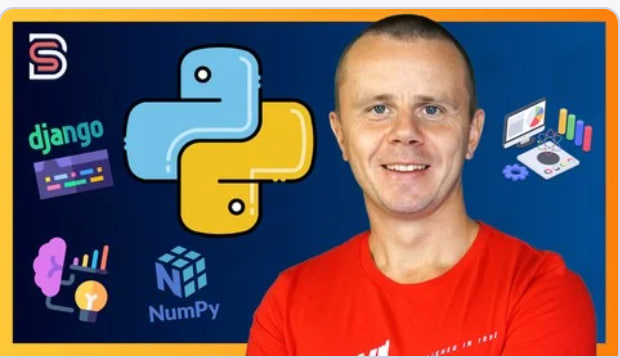
The material covers foundational and applied Python for web development with Jango (Django), Data Science, and ML using Jupyter Notebook and common libraries.
Structure and key topics in Python, Data Science and ML
Includes core syntax and working tools for data processing, visualization, and building machine learning models.
Core libraries: NumPy, Pandas, Matplotlib, Scikit-learn in Jupyter Notebook
- NumPy: arrays, vectors, basic computations.
- Pandas: tables, filtering, aggregation, data preparation.
- Matplotlib: charts, plots, visualization styling.
- Scikit-learn: model selection, metrics, pipelines.
- Jupyter Notebook: experiments, notes, reproducibility.
Syntax and paradigms: variables, lists, dicts, classes, loops, modules, virtual environments
- Data structures and collections.
- Functional and object-oriented programming.
- Project layout, modules, dependencies, virtualenv.
Web in Python with Jango (Django)
Essentials of building web applications: routing, views, templates, and working with data models.
Who this Python + Jango (Django), Data Science and ML course suits and who it does not
Suitable for
- Beginners in programming and data analytics.
- Professionals switching from other languages to Python.
- Analysts, engineers, and researchers working with data.
- QA/BI specialists automating analysis and reporting.
Not suitable for
- Those expecting solutions without writing code.
- Those seeking only a narrow focus (e.g., only web or only ML) without Python fundamentals.
- Those not planning to set up environments and libraries.
Problem → consequence → approach in Python, Data Science and ML
- Problem: fragmented materials → Consequence: gaps in fundamentals → Approach: sequential study of syntax, data structures, and paradigms.
- Problem: difficult data preparation → Consequence: inaccurate models → Approach: Pandas/NumPy workflows, data quality checks, reproducible steps in Jupyter.
- Problem: model choice and evaluation → Consequence: unreliable conclusions → Approach: Scikit-learn, cross-validation, metrics, pipelines.
Comparison with alternatives: approaches to Python, Jango (Django), Data Science and ML
- Books: in-depth but often without interactive notebooks.
- Standalone videos: quick but lacking structure and cohesive examples.
- Narrow programs (only Django or only ML): depth in a single area without a holistic Python base.
- Other languages (R, JavaScript): strong in their niches with different ecosystems and libraries.
Covered learning outcomes in Python, Jango (Django), Data Science and ML
- Core Python syntax and collection handling.
- Data cleaning and analysis with Pandas/NumPy.
- Data visualization using Matplotlib.
- Model building and evaluation in Scikit-learn.
- Working practices in Jupyter Notebook.
- Building simple web apps with Jango (Django).
- Project organization: modules, environments, dependencies.
- Applying OOP and functional approaches in code.
Evaluation
Only authorized users can leave reviews and rate
Log in »



.png)