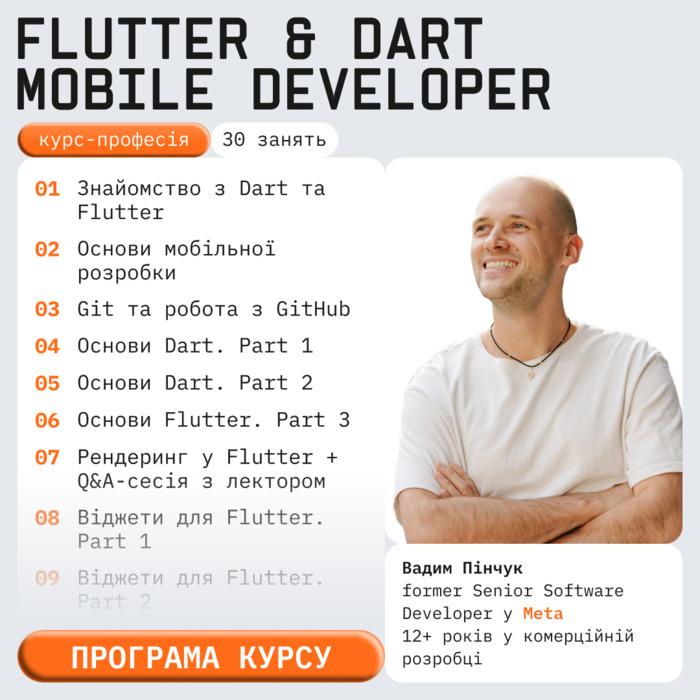
A program focused on Flutter and Dart to build cross‑platform apps for iOS, Android, and Web. Emphasis on UI, performance, architecture, and integrations.
Language of course:
Ukrainian
Format of the event:
Online
Add to collection
you haven't created a collection yet
Add Collection
Course overview
Description generated based on course syllabus and open data.
The program focuses on hands‑on Flutter and Dart to build modern cross‑platform applications for iOS, Android, and Web. It covers UI, state management, architectural patterns, integrations, and performance tuning.
Who it suits and who it doesn’t: Flutter & Dart for the Mobile Developer
- Suits: beginners in mobile development, web engineers transitioning to mobile, native iOS/Android developers seeking faster prototyping and a single codebase.
- Doesn’t suit: cases requiring unrestricted access to all native APIs without wrappers, or projects limited to a single platform with no cross‑platform need.
Common challenges → indicative outcomes with Flutter & Dart
- Challenge: duplicated logic for iOS and Android. Outcome: one Flutter & Dart codebase for both platforms and the Web.
- Challenge: slow UI delivery. Outcome: rapid interface building via widgets and hot‑reload.
- Challenge: unstable state in complex screens. Outcome: proven state management (e.g., Provider/BLoC/Riverpod).
- Challenge: complex integrations. Outcome: REST/GraphQL, push, deep links, analytics, Bluetooth, payments via plugins or platform channels.
- Challenge: performance and jank. Outcome: render optimization, profiling, and isolates.
Alternatives compared for the Mobile Developer
Flutter & Dart vs native iOS/Android
- Single codebase instead of two separate projects.
- Faster UI delivery; native APIs reachable through platform channels.
Flutter & Dart vs React Native
- Rendering decoupled from native UI components, more consistent visuals.
- Fewer JS‑to‑native bridges, more predictable performance.
Flutter & Dart vs Kotlin Multiplatform
- KMP shares business logic while UI is platform‑specific; Flutter provides a full stack from UI to logic.
- Faster start for fully cross‑platform interfaces.
Expected deliverables and competencies after the program
- Skills in building adaptive UI and custom widgets.
- Architectures (MVVM/BLoC) and state management in practice.
- Integrations: networking, local storage, deep links, analytics, notifications.
- Performance profiling and optimization, isolates usage.
- Testing (unit, widget), builds and releases for iOS/Android/Web.
- A training portfolio project: a basic Flutter app built from scratch.
Evaluation
Only authorized users can leave reviews and rate
Log in »