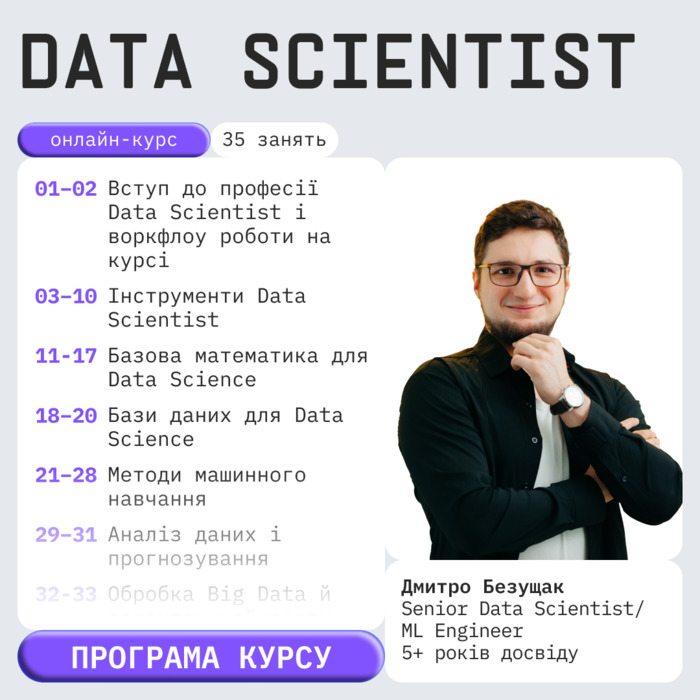
A concise overview of Data Scientist preparation: from math and Python to neural networks and deployment. Structured for systematic data science learning.
Language of course:
Ukrainian
Format of the event:
Online
Add to collection
you haven't created a collection yet
Add Collection
Course overview
Description generated based on course syllabus and open data.
A Data Scientist works with large datasets, turns them into insights and models, and applies machine learning for forecasting. Below is a concise overview of competencies, tools, and practices defining a data science professional.
Who the Data Scientist path fits and who it does not
Fits
- Professionals aiming for a structured track in data science and data analysis.
- Developers and analysts seeking ML, statistics, and big data skills.
- Researchers who need predictive modeling and metric evaluation methods.
Does not fit
- Those avoiding mathematics (linear algebra, probability, statistics).
- Those unwilling to work with code (Python, SQL) and tools such as Docker.
- Those expecting a purely theoretical format without practical tasks.
Problem → outcome in training a data professional
- Fragmented data science knowledge → a structured competency roadmap.
- Weak math foundation → applied linear algebra, probability, and statistics.
- Big data challenges → Big Data tooling and processing automation.
- Uncertainty with ML → classification, regression, clustering, metric evaluation.
- Lack of forecasting practice → Time Series Analysis and prediction building.
- Production gaps → Docker-based containerization, deployment, and basic monitoring.
Comparison with alternatives for a data analysis specialist
Self-directed learning
Flexible with broad source selection; requires more time for curation, quality checks, and building a coherent curriculum.
Adjacent roles: Data Analyst, ML Engineer
Data Analyst focuses on BI and reporting; ML Engineer on infrastructure and production. A Data Scientist combines research analytics, modeling, and experimentation.
Formal education
Provides strong theory; typically longer cycles and less emphasis on production-grade tooling.
Expected outcomes and Data Scientist competencies
- Python for data analysis: NumPy, pandas, visualization (matplotlib, seaborn), unstructured data handling.
- SQL and databases: queries, aggregations, processing optimization.
- Math foundations: linear algebra, probability, statistical hypotheses, A/B testing.
- Machine learning: classification, regression, clustering, model quality assessment.
- Time Series Analysis: series preparation, validation, forecasting.
- Neural networks: TensorFlow, PyTorch, Keras; overview of NLP and Computer Vision.
- MLOps basics: Docker, model deployment, basic monitoring practices.
- Practical work examples: mini-projects and a repository with models and code.
Evaluation
Only authorized users can leave reviews and rate
Log in »