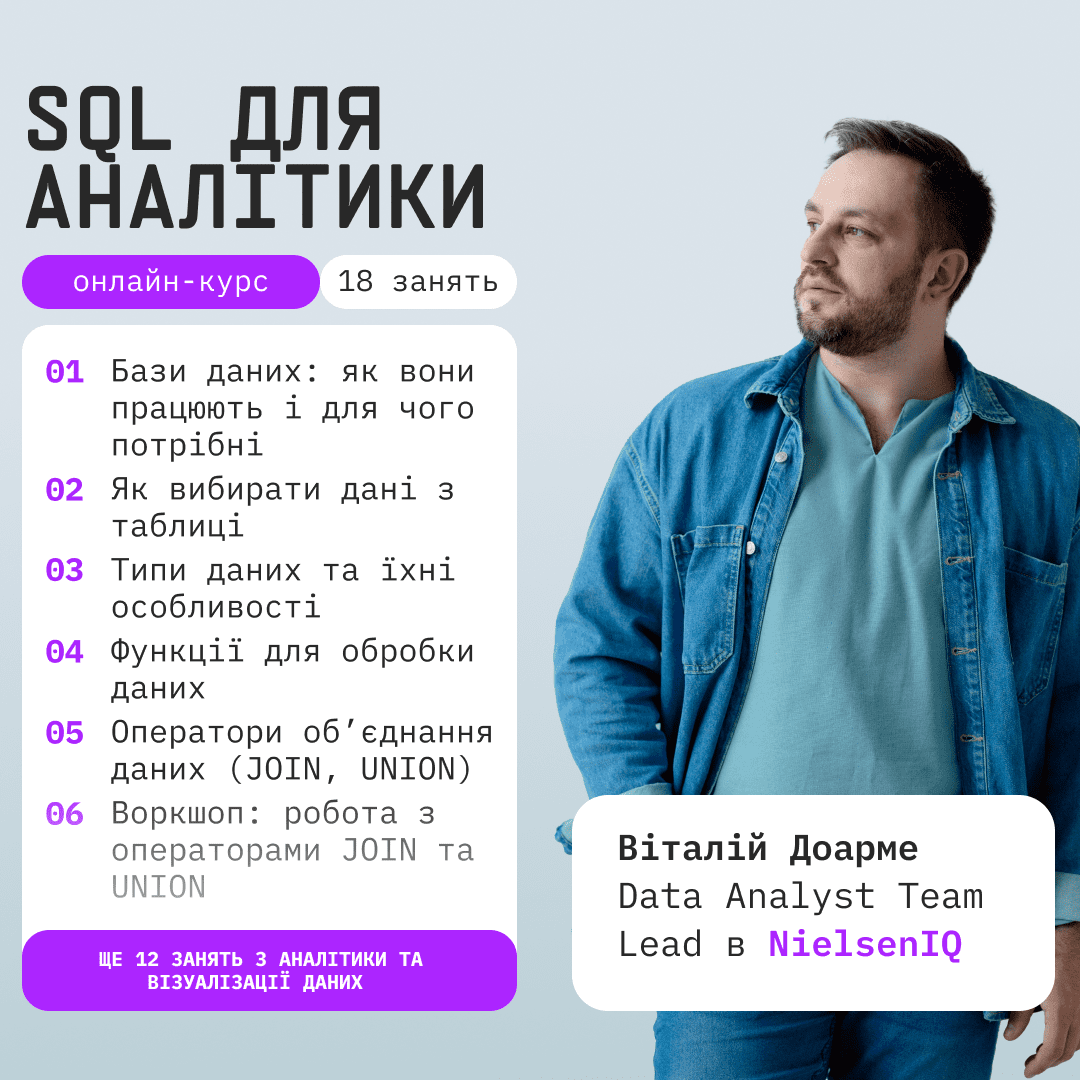
The material focuses on data analysis with SQL. It covers MySQL, BigQuery, and dashboard building in Tableau.
Language of course:
Ukrainian
Format of the event:
Virtual classrooms
Check the price from the partner
Add to collection
you haven't created a collection yet
Add Collection
Course overview
Description generated based on course syllabus and open data.
This material focuses on applying SQL for Analytics: from query structure to presenting insights in Tableau. It covers analytical functions in MySQL, window functions in BigQuery, and core practices for communicating findings to business stakeholders.
Program scope of SQL for Analytics
- Database types and DBMS: relational design, schema basics, normalization.
- SQL query structure: SELECT, WHERE, JOIN, GROUP BY, HAVING, ORDER BY, subqueries.
- 15 key analytical functions in MySQL: aggregations, conditional logic, text and date routines.
- Window functions in BigQuery: OVER, PARTITION BY, ORDER BY, ROW_NUMBER, RANK, LAG/LEAD.
- Visualization: dashboards in Tableau and presentation of analysis results.
Instructor and experience in SQL for Analytics
Vitalii Doarme, Data Analyst Team Lead at NielsenIQ, 12+ years in IT. Leads an analytics team and talent development via PDP. Progressed from Data Engineer to Team Lead at Rakuten Advertising; built SQL procedures for complex data integration, maintained automated ETL, and bootstrapped an analytics system.
Who SQL for Analytics fits and who it does not
Suitable (SQL analytics)
- Beginners in data analysis moving beyond Excel/Google Sheets.
- Marketing, product, or finance specialists needing reproducible database queries.
- Analysts and engineers working with large datasets and BI tools.
Not suitable (SQL for Analytics)
- Those seeking theory only without hands-on database work.
- Those focused solely on certifications without SQL/BI case practice.
- Those not planning to work with relational databases or tabular data.
Problem with data → SQL analytics result
- Scattered data → JOINs and subqueries for a unified view.
- Slow spreadsheet calculations → aggregations and index-friendly queries for stable reporting.
- Manual counting errors → clear, reproducible SQL scripts with version control.
- Complex slices and trends → window functions for dynamic metrics and comparisons.
- Difficult interpretation → Tableau dashboards with interactive filters.
SQL for Analytics vs alternatives
- Excel/Google Sheets: great for small data; SQL scales to millions of rows and complex joins.
- BI without SQL: quick to start, limited flexibility; SQL provides source-level control.
- Python/R: strong for modeling; SQL is efficient for extraction and in-database preprocessing.
Outcomes of SQL for Analytics
- Competencies in writing correct SELECT queries and efficient joins.
- Use of analytical and window functions for metrics, trends, and comparisons.
- Reproducible pipelines from databases to Tableau dashboards.
- Structured communication of analytical findings to stakeholders.
Evaluation
Only authorized users can leave reviews and rate
Log in »