Course overview
Description generated based on course syllabus and open data.
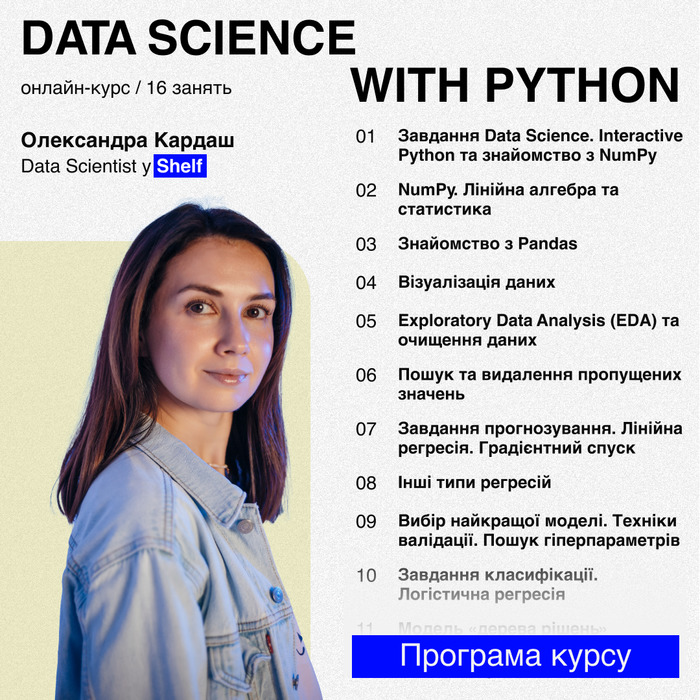
The Data Science with Python course covers the end‑to‑end data workflow: from loading and cleaning to building and validating machine learning models. Modules are organized around realistic tasks: data processing, EDA, visualization, hypothesis testing, A/B experiments, regression, classification, clustering, and feature selection.
Team and experts of Data Science with Python
Lecturer: Oleksandra Kardash — Director of Data Science at Shelf; one of the first Data Scientists at Shelf.io; 5+ years in Forecasting & Time Series, optimization, predictive analytics, and NLP.
Curriculum designer: Iryna Bezkrovna — Technical Data Lead; experience in forecasting, classification, optimization, and data‑driven practices.
Curriculum and tools: Python for Data Science
Focus on 10 libraries and hands‑on cases:
- Data processing: NumPy, Pandas, SciPy
- Visualization: Matplotlib, Seaborn, Plotly, Sweetviz (automated EDA reports)
- Modeling: scikit-learn, Statsmodels, XGBoost
- Practices: data cleaning and missing‑value handling; statistical tests; A/B testing; regression, logistic regression, decision trees, ensembles; clustering; feature selection and dimensionality reduction.
Who Data Science with Python suits, and who it does not
Suitable for (Python for Data Science)
- Analysts, BI specialists, and economists moving from SQL/Excel to Python.
- Developers and QA engineers formalizing data and ML workflows.
- Students and researchers needing EDA, hypothesis validation, and A/B experiments.
- Adjacent roles (PM, marketing, product) working with metrics and experimentation.
Not suitable for
- Those seeking a no‑code or non‑Python course.
- Those needing foundational higher‑math training from scratch — basic algebra and statistics are expected.
- Those expecting deep learning or large distributed systems — these are out of scope.
Typical challenges in Data Science with Python → expected learning outcomes
- Challenge: unstructured CSV/Excel, missing values, artifacts.
Addressed by: cleaning, imputation, transformations in Pandas/NumPy; type and scale alignment. - Challenge: unclear feature effects.
Addressed by: EDA, correlations, visualization with Seaborn/Matplotlib/Plotly; automated Sweetviz reports. - Challenge: hypothesis and effect estimation.
Addressed by: statistical tests, A/B testing, confidence intervals, controls via Statsmodels/SciPy. - Challenge: model selection and validation.
Addressed by: regression, classification, decision trees, ensembles, cross‑validation, hyperparameter search in scikit‑learn and XGBoost. - Challenge: high dimensionality and noise.
Addressed by: feature selection and PCA/other dimensionality reduction methods.
Comparison with alternatives in Python for Data Science
- Self‑paced materials: flexible, but lack a cohesive trajectory and checkpoints.
- Academic courses: strong theory, less focus on day‑to‑day Python engineering practices.
- Non‑Python courses: limited applicability to production data problems.
- Books/documentation: comprehensive yet time‑consuming to curate and assemble practice.
Outcomes of completing Data Science with Python
- A set of working notebooks with EDA, visualizations, and statistical tests.
- Reusable pipelines for data cleaning and transformation in Pandas/NumPy.
- Reference implementations (regression, classification, trees, ensembles) with cross‑validation and tuning scenarios.
- Materials on clustering, feature selection, and dimensionality reduction.
- Sample plans and analyses for A/B experiments with hypothesis checks.