Concise walkthrough of the full SDLC with real-life application from initiation to maintenance. Includes phases, cost estimation, deliverables, risks, and a case study.
Language of course:
English
Format of the event:
Video lectures
Add to collection
you haven't created a collection yet
Add Collection
Course overview
Description generated based on course syllabus and open data.
A practical breakdown of complete SDLC 2025: how the software development lifecycle is applied in real IT projects, what decisions are made at each phase, and which deliverables are produced.
SDLC 2025: what the software development lifecycle includes
- What SDLC is and how SDLC is implemented in IT projects.
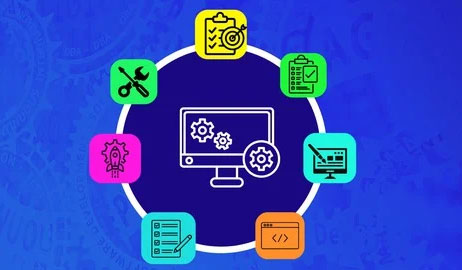
- SDLC phases: initiation, requirements analysis, design, development, testing, release, maintenance.
- Cost and schedule estimation in SDLC: approaches, assumptions, risks.
- SDLC deliverables and outcomes: SRS, design specs, test documentation, CI/CD pipeline, release notes, reports.
- Best practices per phase and common pitfalls with real-life examples.
- End-to-end SDLC case study: from idea to support with measurable quality metrics.
Who SDLC fits and when the lifecycle approach is not suitable
Suitable for
- Analysts, project managers, developers, testers, DevOps engineers, architects.
- Teams adopting formal SDLC phases and requiring reproducible processes and deliverables.
- Organizations that need change control, audits, and compliance.
Not suitable if
- The goal is a one-off prototype without maintenance or documentation.
- No capacity to maintain minimal SDLC artifacts or quality processes.
- Priority is rapid experimentation without traceability of decisions.
Problem → outcome in SDLC (software development lifecycle)
- Ambiguous requirements → formalized backlog and SRS/user stories with acceptance criteria.
- Overestimated timelines → transparent cost/scope estimates with assumptions and buffers.
- Dev–test gap → aligned design artifacts and test cases, shift-left testing.
- Unstable releases → CI/CD, automated quality checks, versioning and release checklists.
- Rising maintenance costs → measurable metrics (MTTR, post-release defects), service plan.
Comparing SDLC with alternatives
- Ad-hoc without process: fast start, low repeatability; SDLC provides phases, artifacts, and change control.
- Pure Waterfall: strong sequencing, low flexibility; SDLC can combine iterations and increments.
- DevOps-only focus: delivery-centric, lacks full analysis/design; SDLC spans the entire lifecycle.
- Agile without SDLC controls: quick iterations, risk of lost traceability; SDLC adds consistent artifacts and traceability.
Outcomes after reviewing SDLC materials
- Distinguish SDLC phases, their inputs/outputs, and roles.
- Apply basic cost estimation and risk management practices.
- Create a minimal artifact set (requirements, design, tests, release docs).
- Use best practices and templates for common scenarios.
- Reference an SDLC case study as a guide for real projects.
Evaluation
Only authorized users can leave reviews and rate
Log in »