The program covers Computer Vision from pixel operations to neural networks for image and video analysis. Delivery is concise and practical, focused on proven tools.
Language of course:
Ukrainian
Format of the event:
Online
Add to collection
you haven't created a collection yet
Add Collection
Course overview
Description generated based on course syllabus and open data.
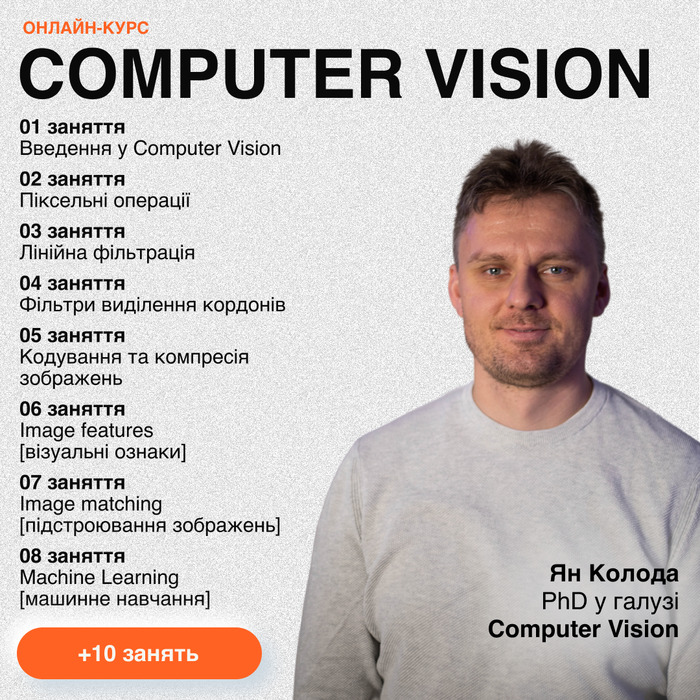
Computer Vision integrates image and video processing with machine learning to interpret scenes, reduce errors, and ensure quality. The program moves from pixel-level operations to deep models for classification, detection, tracking, and segmentation.
What is Computer Vision and computer vision
It is a set of methods and algorithms to extract structured information from visual data: filtering, edge detection, encoding/compression, and ML/DL models for recognition and real-time tracking.
Who it suits / who it doesn’t: Computer Vision
Suitable for
- Engineers with basic Python who want to work with images and video.
- ML/DS/Software engineers aiming to build CV pipelines from data prep to inference.
- Developers needing practical tools: OpenCV, NumPy, scikit-image, PyTorch/TensorFlow.
Not suitable for
- Those expecting theory only without hands-on tasks.
- Those unwilling to engage with math (linear algebra, probability) and optimization.
Problem → outcome in Computer Vision projects
- Fragmented, noisy data → standardized datasets, augmentation, normalization.
- Poor image quality → filtering, sharpening, artifact suppression.
- Overfitting and weak generalization → regularization, cross-validation, hold-out control.
- Real-time constraints → model optimization, encoding/compression, hardware acceleration.
- Pipeline bugs → unit tests, metric monitoring, experiment reproducibility.
Comparison with alternatives: approaches to Computer Vision
- Classical filters only → fast on simple tasks, limited generalization without DL.
- AutoML/cloud services only → quick start, less control over quality and costs.
- General ML without CV specifics → lacks image/video tooling and inference optimization.
Developed competencies in Computer Vision
- Image and video processing: pixel ops, filtering, edges, encoding and compression.
- CV pipeline building: data prep, annotation, metrics, validation.
- DL models: classification, detection, tracking, segmentation; basic optimization practices.
- Inference and deployment: latency reduction, format conversion, quality monitoring.
Curriculum and tools for Computer Vision
Topics
- Pixel operations, color transforms, geometric transforms.
- Filtering, edge detection, morphology.
- Encoding, compression, image/video formats.
- Classification, detection, tracking, segmentation with ML/DL.
Tools
- Python, NumPy, OpenCV, scikit-image.
- PyTorch/TensorFlow, torchvision, Albumentations.
- ONNX, inference optimization, basic MLOps practices.
Lecturer: Computer Vision & Machine Learning
Yan Koloda — Senior Computer Vision & Machine Learning Engineer at Gini GmbH, PhD in Image Processing & Computer Vision. Worked on document information extraction (adopted by major German banks), designed DL pipelines for autonomous driving at AVL, and anti-spoofing at Veridas (>99% accuracy). Taught CV/image processing at the University of Granada and FAU Erlangen-Nürnberg.
Prerequisites and format
- Basic Python, linear algebra, probability, ML foundations.
- Practice with Git and execution environments (Jupyter/IDE) is recommended.
Evaluation
Only authorized users can leave reviews and rate
Log in »



.png)